
Process

Governance, risk, and compliance evidence connected to live cyber operations.

SecureSist GRC turns policies, controls, risk registers, audit evidence, and executive reporting into a connected governance layer rather than isolated compliance documentation.

05 Roadmap-ready

Animated Module Intelligence View

A client-facing preview of the live dashboards, intelligence signals, and executive evidence this module turns into action.

Automated Compliance Checklist
Risk Register Heat Map
Control Evidence Vault
Executive Security Report
Deep-Dive Enterprise Architecture

Content-complete module narrative for enterprise buyers.

Core Functionality

This phase maps cybersecurity activities to frameworks, control owners, evidence requirements, risk decisions, and board-level reporting. It connects the operational platform to governance language so auditors and executives can see defensible cyber maturity.

  • Institutional governance, risk, and compliance frameworks mapped to controls and evidence.
  • Automated corporate risk assessment and mitigation engine with ownership and residual risk tracking.
  • Executive security reports that summarize posture, exceptions, audit readiness, and improvement plans.
Enterprise Pain Points Solved

GRC removes spreadsheet-driven governance and disconnected audit evidence. It reduces policy inconsistency, missing proof, manual reporting, weak control ownership, and the inability to translate technical risk into business accountability.

  • Audit evidence scattered across emails, folders, and manual spreadsheets.
  • Control owners unclear about responsibilities, status, and overdue evidence.
  • Risk registers disconnected from actual vulnerabilities, incidents, and remediation.
  • Executives receiving compliance summaries without operational proof.
Visual System Dashboard Mockup Zone

High-fidelity inner-system skeleton for analysts and executives.

A GRC command dashboard combines automated compliance checklists, control evidence, risk heat maps, executive security reports, exceptions, and audit readiness timelines.

SECURESIST COMMAND CENTER
GRAPH ENGINE
LIVE FEED
Automated Compliance Checklist
Risk Register Heat Map
Control Evidence Vault
Executive Security Report
EXECUTIVE REPORT
214 Controls Mapped
89% Audit Ready
31 Residual Risks
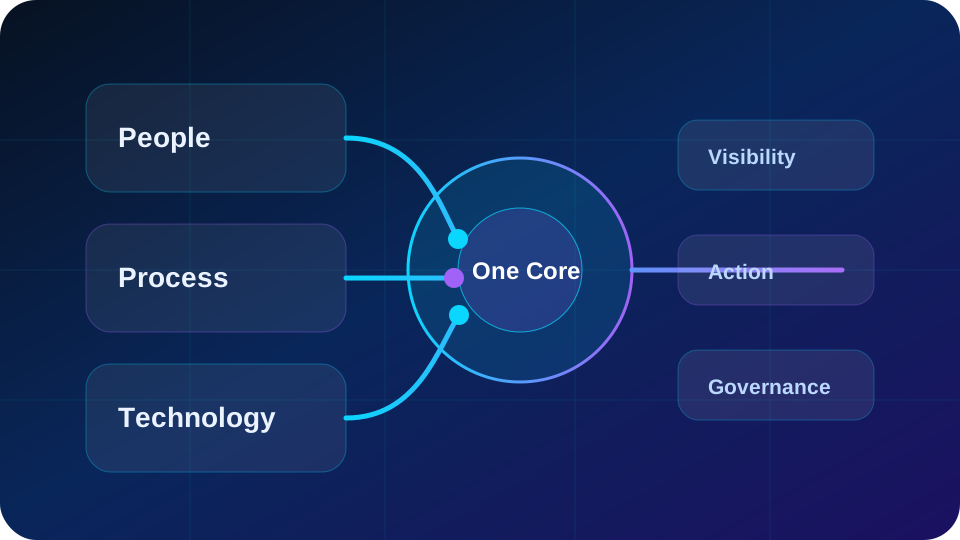
Three Essential Cyber Pillars

Every module connects back to the same enterprise cyber operating model.

Each pillar is presented as a high-contrast enterprise container with a software-style mockup and precise content mapping for client-ready design and WordPress development.

Pillar 1

PEOPLE

People is the enterprise layer that measures and improves employee behavior before it becomes incident volume. It connects training, policy adoption, insider-risk signals, and simulated phishing into one human-risk cockpit.

  • Comprehensive Security Awareness Training Modules
  • Human Threat Vector Modeling & Inner Risk Management
  • Employee Cyber Hygiene Policies & Simulated Phishing Metrics
Simulation Cockpit Dashboard Live human risk score gauge, phishing test progress, and awareness compliance charts.
Pillar 2

PROCESS

Process turns cyber activity into governed, repeatable execution. It gives teams a shared operating language for risk assessment, GRC, approvals, playbooks, ownership, and incident response momentum.

  • Automated Corporate Risk Assessment & Mitigation Engine
  • Institutional Governance, Risk, and Compliance Frameworks
  • Real-Time Playbooks for Orchestrated Incident Response
Compliance and Response Orchestration Automated compliance checklist beside an incident response node tree tracking active mitigations.
Pillar 3

TECHNOLOGY

Technology is the operational telemetry layer for assets, systems, devices, cloud, endpoints, vulnerabilities, and controls. It shows what is protected, exposed, misconfigured, and actively changing.

  • Network Infrastructure & Security Device Integration
  • Automated Continuous Vulnerability Assessment Scanning
  • Real-Time Endpoint, Cloud, and Asset Security Telemetry Protection
Interactive Graph Engine Connected network nodes, vulnerability scanners, and a live threat processing matrix.
Operational Flow

How this module moves from signal to accountable action.

01

Map frameworks, controls, policies, and owners.

02

Collect evidence from operational security workflows.

03

Track risk decisions, exceptions, and residual exposure.

04

Generate audit and board-ready reporting packs.